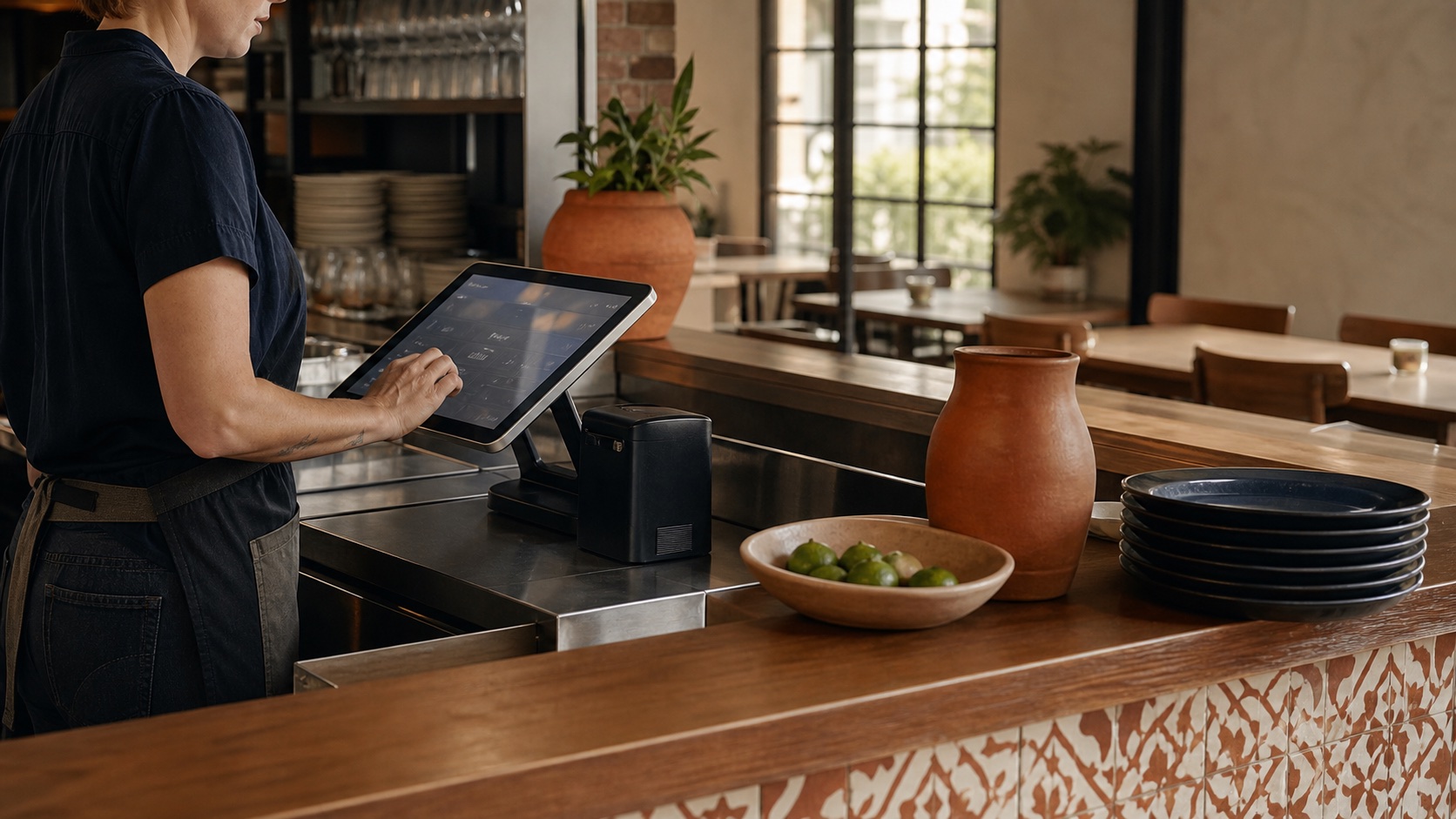
Start with a measurable bottleneck, keep the human owner visible and judge the tool by time saved, fewer errors or stronger demand—not by how futuristic the demo looks.
The National Restaurant Association’s 2026 hiring and staffing research reports that 26% of operators use AI tools. Among that group, the most commonly reported use is marketing at 63%, followed by administrative tasks at 38%, menu optimization and employee scheduling at 26% each, customer ordering at 25%, and recruitment and inventory management at 21% each.
Those figures describe uses among adopters, not the entire restaurant industry. That distinction matters: AI is helping some operators produce campaign variations, organize routine work, forecast staffing, improve menu decisions, assist ordering and watch inventory, but most operators in the survey were not yet using it.
The better implementation question is not where AI can be placed, but which recurring problem has reliable data and a clear human owner. A restaurant can pilot one workflow, compare speed and error rates against the old process, preserve an easy staff override and expand only when the business result is visible.
The same report found that 94% of operators said recent technology investments had not permanently eliminated jobs. That does not predict every future use, but it supports a current reading of restaurant AI as an operating aid more often than a wholesale replacement for hospitality staff.
Six jobs AI can support without becoming the restaurant strategy
Marketing tools can create first drafts, resize content, organize a photo library and produce variations for different dayparts. Operations tools can summarize recurring reports, forecast prep or staffing inputs, flag inventory anomalies and help managers compare menu performance. Ordering assistants can handle routine questions when the menu and availability data are accurate.
Each use requires a different quality standard. A caption error may be embarrassing; an allergen, price, availability or schedule error can harm a guest or employee. Restaurants should classify workflows by consequence and require more human review as the consequence rises.
- Marketing: image improvement, draft copy, campaign variations and content organization.
- Administration: summaries, document classification and recurring reports.
- Menu: contribution analysis, demand patterns and testing ideas—not invented food facts.
- Labor: forecast support and schedule suggestions with manager approval.
- Ordering: FAQs and guided choices with a visible human fallback.
- Inventory: anomaly alerts and suggested actions verified against real counts.
A 90-day pilot that can produce a real answer
Choose one location, one workflow and one owner. Record the baseline before enabling the tool: minutes spent, errors, response time, waste, conversion or another outcome tied to the problem. Define what the AI may do, what requires approval and what it must never publish or change.
Review weekly with frontline staff. They will see failure patterns earlier than a dashboard: awkward guest language, suggestions that ignore kitchen reality, duplicate work or alerts nobody can act on. At day 90, expand only if the result survives labor cost, correction time, subscription cost and customer impact.
- Baseline: document the old process before the demo changes expectations.
- Guardrails: define data, actions and claims the tool cannot use.
- Human owner: name the person accountable for review and correction.
- Outcome: measure the business result after correction time is included.
- Exit test: confirm data and workflows can be exported or shut down cleanly.
Questions to ask now
- Which bottleneck has a measurable baseline?
- Who owns the result and the correction when AI is wrong?
- Can the restaurant test one workflow before adding another?
This analysis adds original business context to reporting from National Restaurant Association. We link to the original publication and do not reproduce its article.
Read the original source ↗