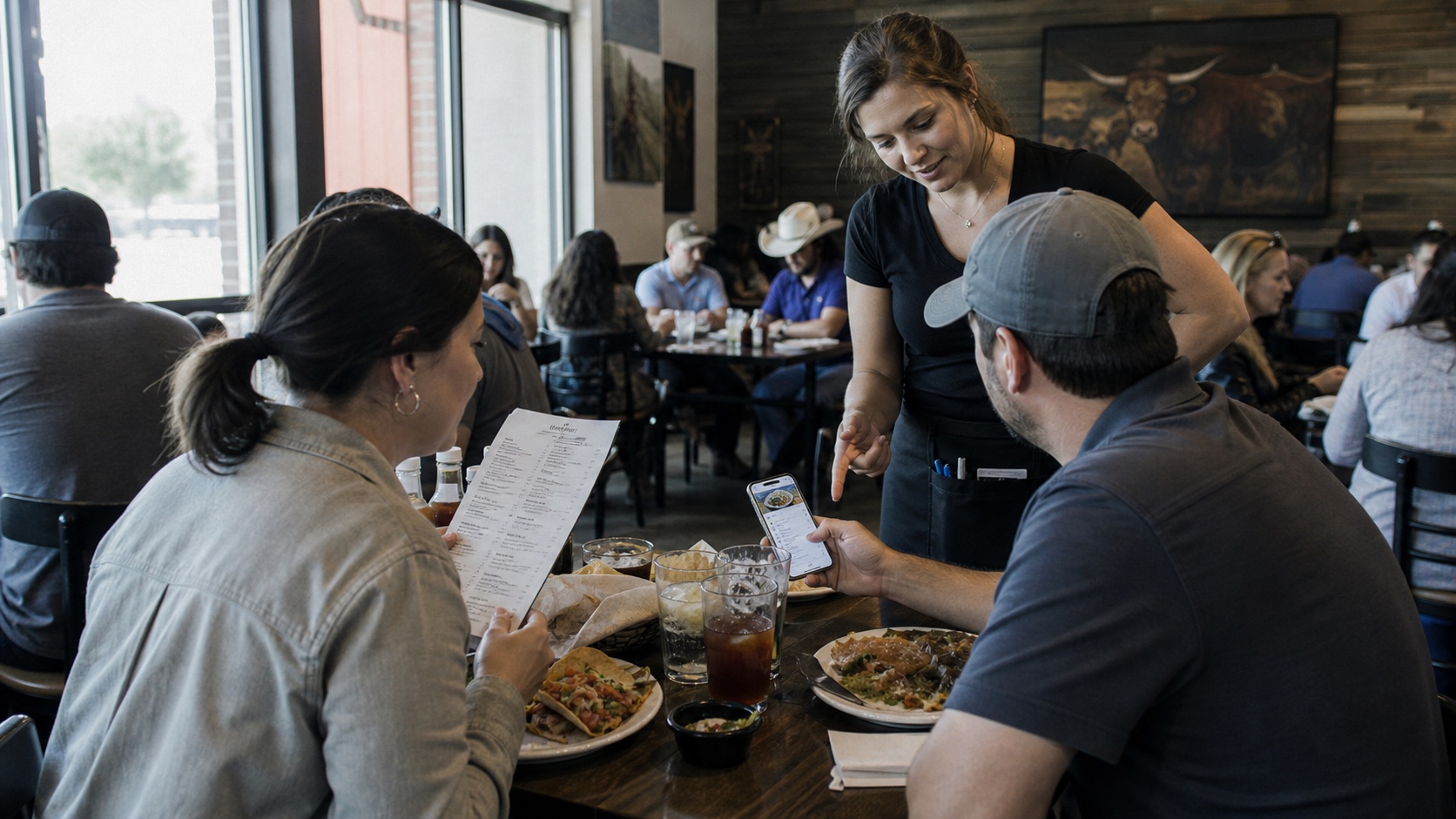
Automate a defined inconvenience, disclose the automation, and keep a visible route to a staff member.
Fast Casual reported on an August 24 survey release from restaurant-technology provider PAR. In a June survey of 1,000 U.S. adults, nearly three in four respondents were open to some role for AI in the restaurant experience, particularly when it improved speed or consistency.
Because the research was commissioned by a company that sells restaurant technology, operators should treat it as a signal to test—not as a universal forecast. The more durable finding is conditional acceptance: diners want transparency and an option to reach a human worker.
A Texas restaurant can apply that standard to ordering, loyalty and guest messaging. Start with one measurable friction point, explain when automation is being used, and make recovery simple when the system gets an order or preference wrong.
Useful and optional are operating requirements
Guests do not experience an AI strategy; they experience a faster order, a relevant answer or a frustrating dead end. The tool earns its place when it removes a specific delay without making the guest learn a new system. It loses trust when automation is hidden, repeats questions or prevents a person from correcting the order.
Restaurants should define the human exit before launch. A guest who types ‘person,’ rejects a suggestion, mentions an allergy, disputes a charge or reports a missing item should move to an employee with the conversation context intact. Requiring the guest to begin again cancels much of the efficiency the automation promised.
- Ordering: disclose assistance before it changes or submits the order.
- Recommendations: use current menu and availability data.
- Loyalty: explain why a message or offer is relevant.
- Recovery: preserve the cart, conversation and error for staff.
- Accessibility: do not make automation the only usable channel.
What to measure beyond adoption
Usage alone can hide a poor experience. Track completion, corrections, staff takeovers, time to resolution, refunds, abandoned carts and repeat contacts for the same issue. Compare results by channel and daypart because a tool that helps at midnight may slow down a staffed lunch rush.
Include qualitative review. Sample conversations and orders every week, remove personal information where possible and let frontline employees classify failure patterns. Guest complaints that mention confusion, lack of control or inability to reach staff are product signals, not just customer-service incidents.
- Completion rate without employee correction.
- Average time from first message to resolved need.
- Share of conversations transferred and why.
- Order-error and refund rate compared with the prior channel.
- Guest opt-outs, complaints and repeat-contact rate.
PAR Technology commissioned the survey and sells restaurant technology. The sample is useful as a directional signal, not independent proof of market-wide demand.
Questions to ask now
- What customer problem does the AI remove?
- Is the use of automation disclosed at the right moment?
- Can a guest reach a person without starting over?
This analysis adds original business context to reporting from Fast Casual, reporting on a PAR Technology survey. We link to the original publication and do not reproduce its article.
Read the original source ↗