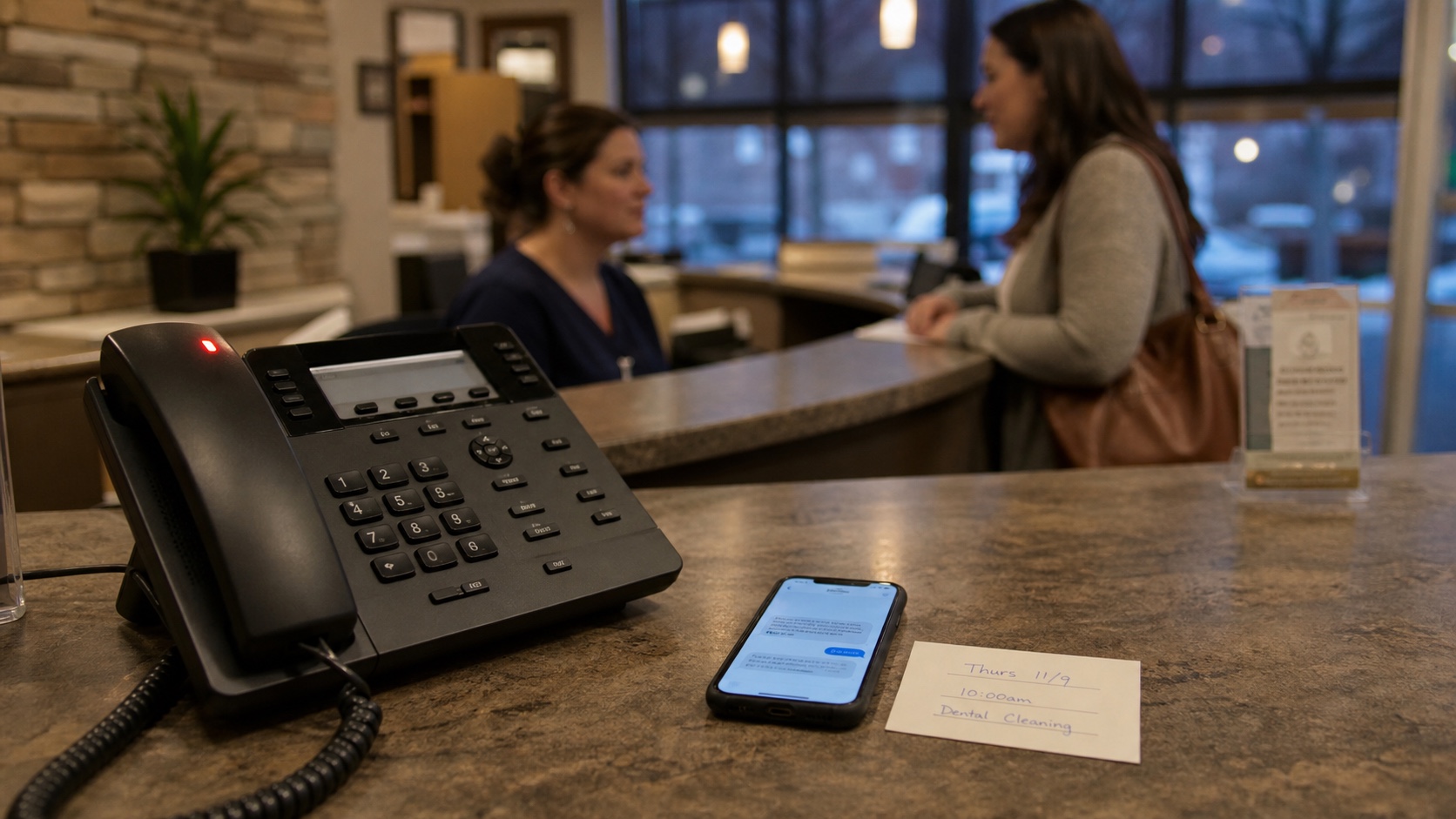
Evaluate scheduling products as an end-to-end communication system, not just a calendar: missed calls, consent, messages, booking rules, exceptions and staff handoff all belong in the review.
A March 2026 ADA News announcement describing an endorsed patient-engagement platform illustrates where dental scheduling products are heading. The featured AI receptionist can follow a missed call with a text, answer common questions, let a patient schedule and escalate the conversation to staff.
The meaningful change is continuity. A prospective patient no longer has to repeat the same request across voicemail, text and an online calendar. For a practice, that can make after-hours demand visible and reduce the number of leads that disappear between first contact and a confirmed appointment.
This convenience should be tested against real operating rules: which appointment types can be self-booked, what information may appear in a text, how urgent or clinical language is detected, when staff take over, and how cancellations or incorrect bookings are corrected. The best workflow is easy for the patient and observable for the practice.
The patient journey now has four connected stages
Discovery, first contact, booking and confirmation used to live in separate tools. The newer model links them: a person finds the practice, calls or messages, receives an immediate approved response, sees valid appointment options and gets a confirmation in the preferred channel. The handoff history remains visible to staff.
Continuity reduces repetition, but only if the underlying rules are accurate. Appointment duration, provider eligibility, new-patient requirements, insurance questions, emergency language and location must be modeled explicitly. Otherwise the system simply moves an error faster from the first message into the calendar.
- Before booking: source, reason for contact and preferred channel.
- During booking: valid service, provider, location and duration.
- After booking: confirmation, forms, directions and rescheduling path.
- Exception path: urgent language, uncertainty or patient request for a person.
Questions to use in a vendor demonstration
A polished demo rarely shows the edge cases that consume staff time. Ask the vendor to use the clinic’s actual scheduling rules and demonstrate a cancellation, a duplicate patient, a bilingual conversation, an unavailable procedure, an insurance question and a request to speak with staff. The practice should see the audit trail for each case.
The buying decision should include ownership and exit. Confirm who owns conversation data, whether it can be exported, how long it is retained, which integrations can write to the calendar, who supports failures after hours and what happens to patient information when the contract ends.
- Can staff correct a booking without creating a duplicate?
- Can the system explain why it offered a specific slot?
- Can a manager pause one channel without shutting down everything?
- Are handoffs and patient opt-outs visible in reporting?
The source is an ADA endorsement announcement about Weave, a commercial vendor. We use it as a product-direction example, not independent evidence that one platform is superior.
Questions to ask now
- Can a patient move from missed call to confirmed appointment without repeating information?
- Which appointment types require staff approval?
- Does every automated path have a visible owner and correction process?
This analysis adds original business context to reporting from ADA News. We link to the original publication and do not reproduce its article.
Read the original source ↗